
Welded Differential
vs. LSD
Which is correct for You?
If you are building a drift car, one of the biggest driveline decisions is whether to run a welded differential or install a limited-slip differential. Both can keep both rear tires involved when the car is sideways, but they accomplish that in very different ways. They also have very different costs.
For a dedicated drift car, a properly prepared welded differential can provide consistent, permanent lock without requiring a $1,000 to $2,000 aftermarket LSD. For a car that sees significant street driving, road course use or other applications where differential action is desirable, an LSD may be worth the additional expense.
So which one makes sense for your car?
What Is a Welded Differential?
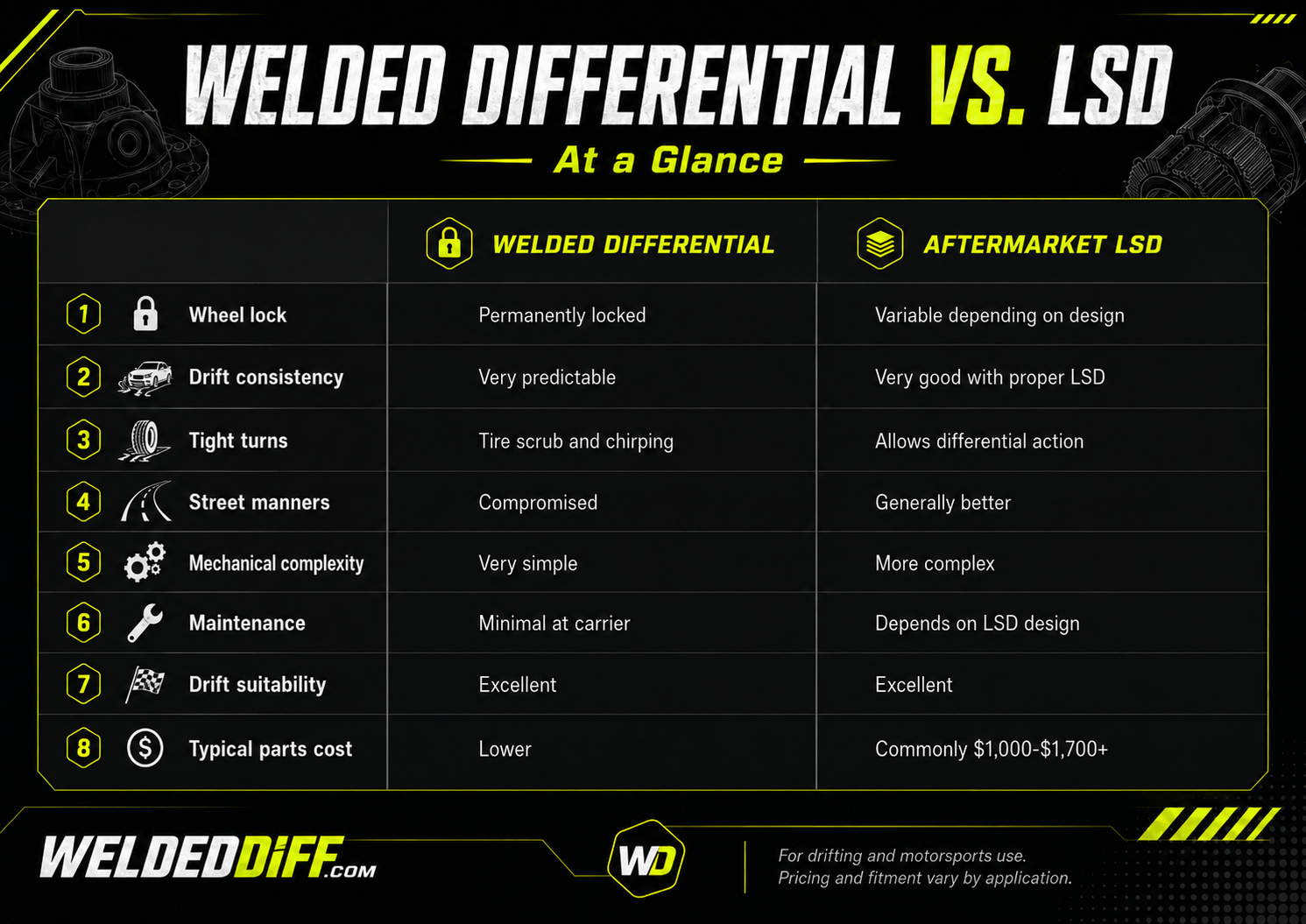
A welded differential starts with an existing differential carrier. The internal gears are permanently welded together so the left and right axle outputs can no longer rotate independently.
The result is effectively a permanently locked differential.
Whenever one rear wheel is driven, the other is driven at the same speed. There are no clutch packs, viscous couplings or locking mechanisms determining when the differential should engage.
For drifting, that simplicity is one of its biggest advantages.
What Is a Limited-Slip Differential?
A limited-slip differential, usually shortened to LSD, allows some difference in speed between the left and right wheels while limiting excessive slip between them.
There are several types of LSDs, including:
Clutch-type differentials
Helical or torque-biasing differentials
Viscous limited-slip differentials
Other mechanical locking designs
For drifting, clutch-type 1.5-way and 2-way LSDs are particularly popular because they can provide aggressive lockup while still allowing differential action under certain conditions.
Unlike a welded differential, however, an LSD is not necessarily locked all the time.
Welded Diff vs. LSD At A Glance
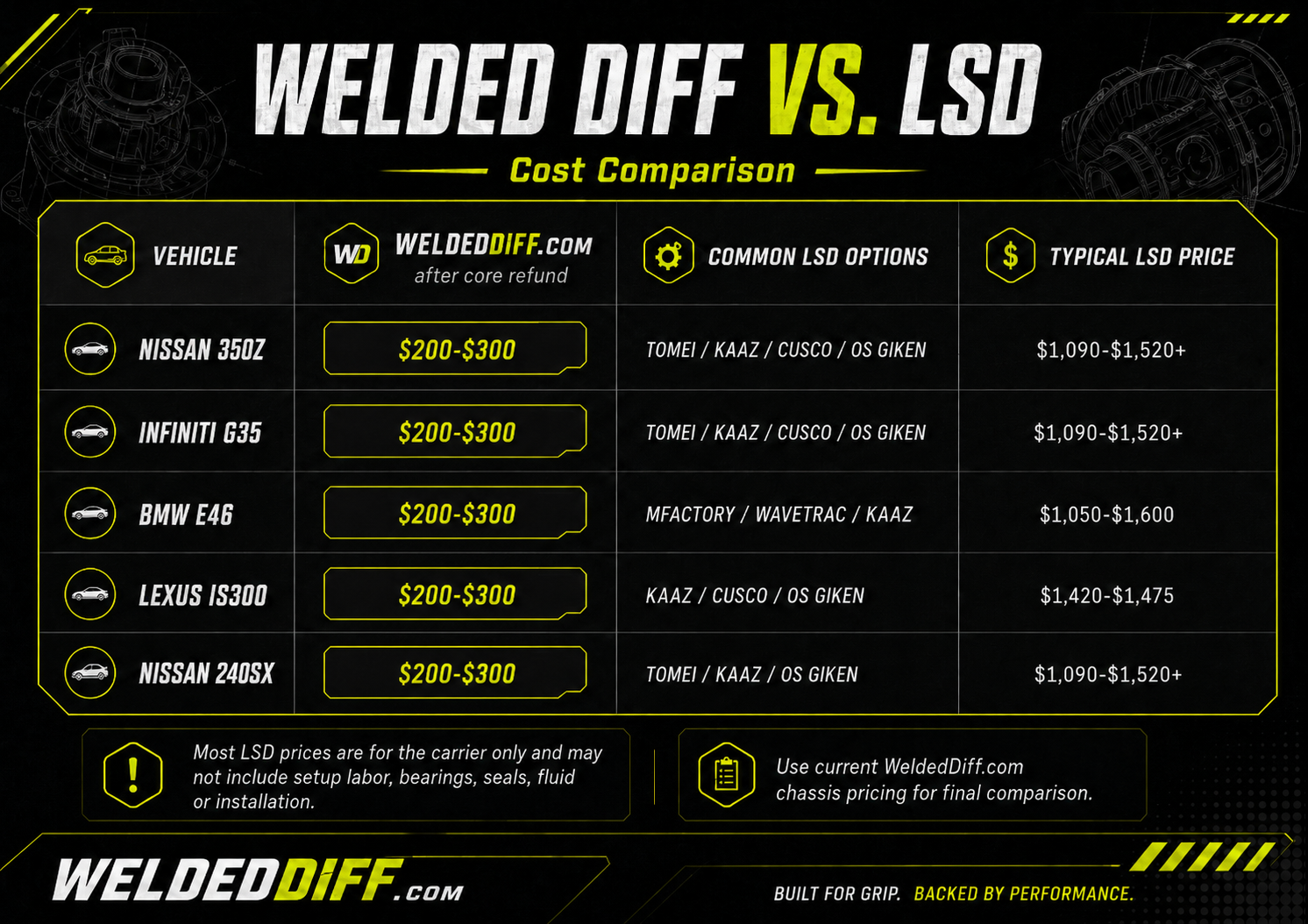
Welded Differential vs. LSD Cost by Vehicle
Why Would Anyone Pay More for an LSD?
Because an LSD has real advantages.
An LSD may be the better option if you:
Drive the car extensively on the street
Want smoother low-speed turning
Want less tire scrub during normal driving
Want differential action when it is beneficial
Prefer progressive lockup rather than permanent lock
Are building a multipurpose performance car rather than a dedicated drift car
A quality LSD can provide excellent performance and much better everyday road manners than a welded differential.
We're not arguing that an LSD is a bad product. We're asking whether you actually need one for what you're building.
Why a Welded Differential Makes Sense for Drifting
If the primary objective is drifting, many of the features that make an LSD sophisticated become less important.
A drift car needs both rear wheels to behave predictably. A welded differential gives you:
Permanent Lock:
There is no waiting for the differential to engage. Both rear axle outputs remain mechanically locked together.
Consistency:
The differential behaves the same way every time. There are no worn clutch packs, viscous elements or changing lock characteristics to account for.Simplicity:
A welded carrier contains no additional limited-slip mechanism that needs to determine when or how aggressively to lock.Cost:
This is the big one. Instead of spending well over $1,000 on an LSD carrier alone, a welded differential can provide the locked behavior required for drifting at a substantially lower cost.
What About a Factory VLSD?
Many vehicles, including the Nissan 350Z and Infiniti G35, were available with factory viscous limited-slip differentials.
A healthy VLSD can provide better traction than an open differential, but viscous units rely on fluid inside a sealed coupling to create resistance between the outputs.
Their behavior is not the same as a permanently locked differential or a mechanical 2-way LSD. For a drift application where consistent lock is the priority, some drivers choose to weld the differential rather than rely on an aging factory VLSD.
The good news… If you have a worn out VLSD, we can weld it. We’ve had great success and durability welding Nissan VLSDs. Check out our Nissan 350z page for more details.
Welded Diff vs. 2-Way LSD
A 2-way clutch LSD is designed to provide locking action during both acceleration and deceleration. KAAZ specifically describes its 2-way configuration as being favored for drifting because of its lock characteristics under acceleration and deceleration.
That can provide excellent control in a drift car. But a good 2-way LSD can easily cost $1,200-$1,700 before installation.
A welded differential takes a simpler approach. There is nothing to engage. It is already locked.
For many grassroots drift cars, that is exactly what the driver wants.
Which Should You Choose?
Choose a welded differential if:
Your car is primarily built for drifting, you want permanent rear-wheel lock and keeping the build affordable matters.
Consider an LSD if:
Your car spends substantial time on the street, you use it for multiple forms of motorsports or you want better low-speed and normal-driving behavior.
Neither solution is universally better. They solve slightly different problems.
For a Dedicated Drift Car, the Math Is Pretty Simple
If your goal is predictable lock from both rear wheels, spending $1,000-$1,700 or more on an aftermarket LSD may not be necessary.
WeldedDiff.com offers professionally prepared welded differentials for supported drift platforms without requiring you to source a differential, locate a welder or have an aftermarket LSD installed and set up.
More Questions?
You’re in luck. We have put together an exhaustive FAQ page, organized by topic. Check it out.