
Why Choose A Welded Diff For Drifting?
Predictibility, Simplicity & Affordability
A welded differential is one of the simplest and most effective ways to create predictable rear-wheel lock in a drift car.
In a standard open differential, the left and right drive wheels are allowed to rotate at different speeds. That is ideal for normal street driving, but it can create problems when you are trying to drift. If one rear tire loses traction more easily than the other, an open differential can allow that tire to spin while the other receives much less usable drive.
A welded differential eliminates that behavior by permanently locking the two axle outputs together. Both rear wheels rotate at the same speed, giving the driver consistent and predictable rear-wheel behavior during initiation, transitions and sustained drifting.
For many grassroots drift cars, that is exactly what is needed.
Consistent Lock, Every Time
One of the biggest advantages of a welded differential is consistency. There is no clutch pack that needs to engage, no viscous coupling that changes behavior as it heats up and no electronic system deciding when the differential should lock. It is always locked. That means the driver knows what the rear of the car is going to do when power is applied. Both rear tires remain mechanically connected whether you are initiating a drift, transitioning from one direction to another or staying on throttle through a long corner.
For a developing driver, that consistency can also make the car easier to understand. Instead of wondering whether the differential will lock, the driver can focus on throttle control, steering input and vehicle placement.
Both Rear Tires Stay Involved
Drifting depends heavily on controlling rear tire slip. With an open differential, one rear tire can spin substantially faster than the other. That can make the car inconsistent and may cause it to straighten unexpectedly when the differential sends more usable torque to one side than the other. A welded differential forces both rear wheels to rotate together. When the rear tires break traction, they do it as a pair.
That can make it easier to maintain wheel speed, carry angle and use throttle to control the car throughout the drift.
Predictable Transitions
Transitions are one of the places where differential behavior becomes especially noticeable. As the car changes direction, the load on the rear tires shifts quickly from one side to the other. A differential that locks inconsistently can make this transition harder to predict. Because a welded differential is permanently locked, its behavior does not change depending on which rear tire has more traction. The result is a very direct, repeatable response that many drift drivers prefer.
Simple Mechanical Design
A welded differential does not rely on a complex locking mechanism. Once the differential gears are properly welded, there are no additional clutch packs, ramps or internal limited-slip components required to create the locked condition. That simplicity is one of the reasons welded differentials have remained popular in grassroots drifting for so long. There is simply less happening inside the carrier.
Cost Is a Major Advantage
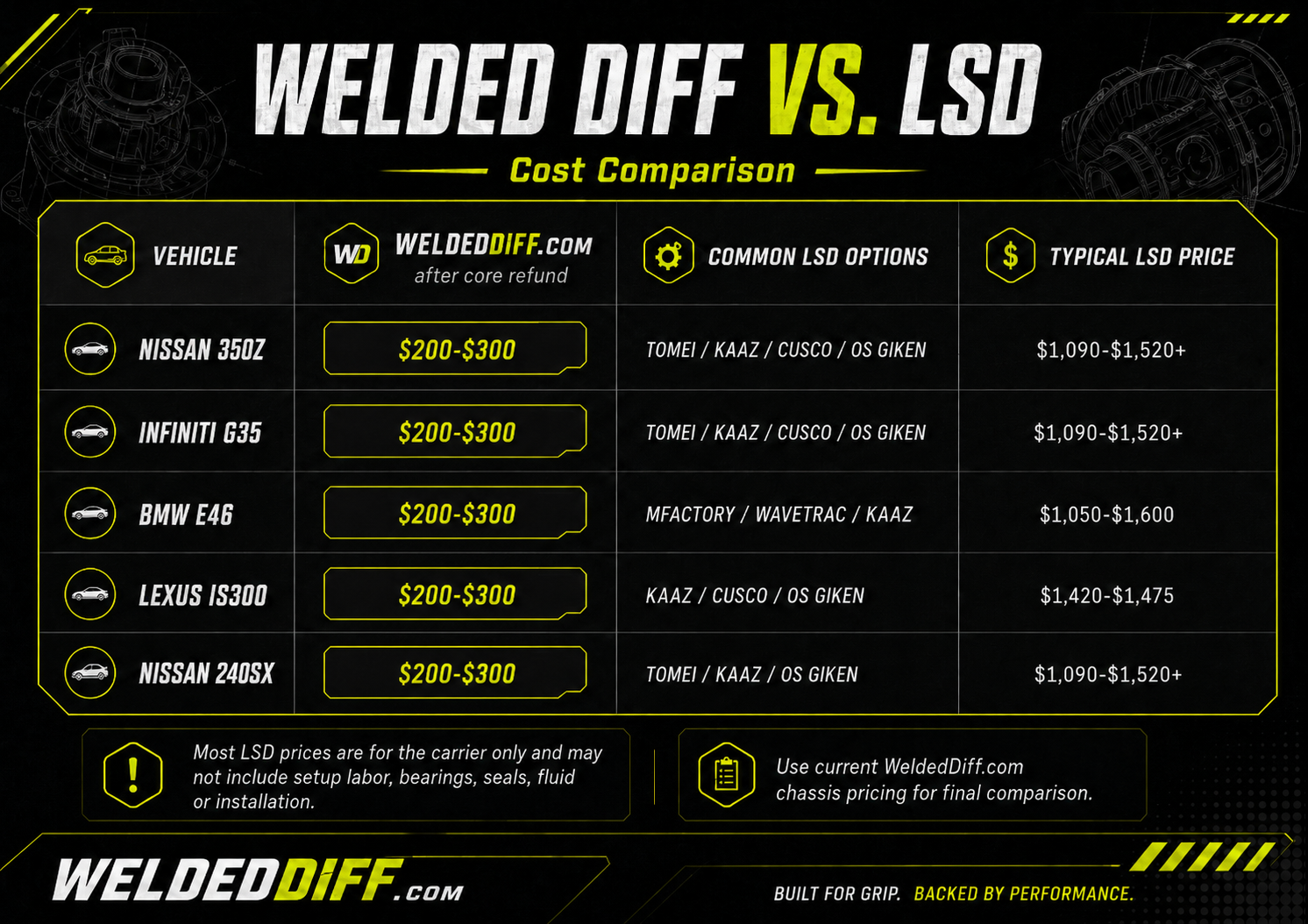
A quality aftermarket limited-slip differential can easily cost more than $1,000 before installation, bearings, seals, fluid and differential setup.
For a dedicated drift car, that can be a significant amount of money to spend simply to achieve reliable rear-wheel lock.
A welded differential accomplishes that goal much more affordably.
WeldedDiff.com welded differential products typically fall in the $200 to $300 range after the applicable core refund, depending on the vehicle and differential configuration.
For a grassroots drift build, that price difference can leave a substantial amount of the budget available for things like:
Tires
Suspension
Cooling
Steering angle
Seat time
Maintenance
Track entry fees
A welded differential is not a substitute for every type of LSD, but if the primary goal is consistent lock for drifting, it can be an extremely cost-effective solution.
No Waiting for an LSD to Lock
Different types of limited-slip differentials behave differently.
A clutch-type 2-way LSD can provide excellent lock for drifting, but it still relies on its internal mechanism to create that lock. Factory viscous limited-slip differentials can behave even more differently depending on age, condition and temperature.
A welded differential removes that variable.
There is no lockup percentage.
There is no engagement point.
There is no question about whether it is going to lock.
The rear axle outputs are mechanically connected all the time.
Why Not Just Drift With an Open Differential?
You can attempt to drift a car with an open differential, but it usually makes the car much less predictable. An open differential allows the rear wheels to rotate independently. When one tire loses traction, that tire can spin much faster than the other. This often results in the classic "one-wheel peel," where one rear tire produces most of the wheelspin.
For drifting, that can make it difficult to maintain consistent wheel speed and control the car with the throttle. Locking the differential removes that uncertainty.
What About a Factory VLSD?
Some popular drift platforms, including the Nissan 350Z and Infiniti G35, were available with factory viscous limited-slip differentials.
A functioning VLSD can provide better traction than an open differential, but it does not behave like a permanently locked differential.
Viscous differentials rely on resistance inside a sealed coupling to limit differences in wheel speed. Their effectiveness can also change as the unit ages. For a street-driven performance car, that can be perfectly acceptable. For a drift car where consistent rear-wheel lock is the priority, some drivers prefer the predictable behavior of a welded differential.
If you have a Nissan with a VLSD that is starting to misbehave, check out our VLSD welding service. No need to source a new diff pumpkin. Let us help.
Welded Diff vs. 2-Way LSD
A quality 2-way LSD is arguably the closest alternative to a welded differential for a serious drift car. Both can provide excellent performance. The biggest differences are cost, complexity and street behavior.
A 2-way LSD can still allow some differential action, which makes the car more manageable during normal driving. It can also provide progressive lockup characteristics that experienced drivers may prefer.
A welded differential takes the simpler approach. It is locked all the time. For a multipurpose street and track car, a good 2-way LSD may be worth the additional cost.
For a dedicated or primarily drift-focused car, a welded differential may provide everything the driver needs for a fraction of the price.
Is a Welded Differential Right for Your Drift Car?
If your priority is consistent rear-wheel lock, predictable drift behavior and keeping the build affordable, a welded differential can make a lot of sense. It is particularly attractive for:
Dedicated drift cars, grassroots competition cars, track-only builds and budget-conscious drift projects where street comfort is not the primary concern.
If your vehicle spends substantial time on the street or is used for multiple forms of motorsports, an aftermarket LSD may offer a better compromise.
Neither solution is right for every car. The important question is what you want the differential to do. For many drift cars, the answer is simple: Lock both rear wheels and keep them locked.
A Better Way to Get a Welded Differential
WeldedDiff.com is designed to make that process easier, faster and more reliable.
We offer professionally TIG-welded differential carriers and vehicle-specific exchange products for popular drift platforms.
That means you can purchase the correct welded carrier for your application, install it and return your eligible original carrier afterward to receive your core refund. You also get a warranty.
No searching for a spare carrier.
No wondering whether the part will fit.
No trying to find someone locally who knows how to weld a differential correctly.
Built for Drifting
WeldedDiff.com products are designed specifically around drift and motorsports applications.
Our focus is on known fitment, professional TIG welding, standardized preparation, clear core exchange requirements and technical support when you need it.
More Questions?
You’re in luck. We have put together an exhaustive FAQ page, organized by topic. Check it out.